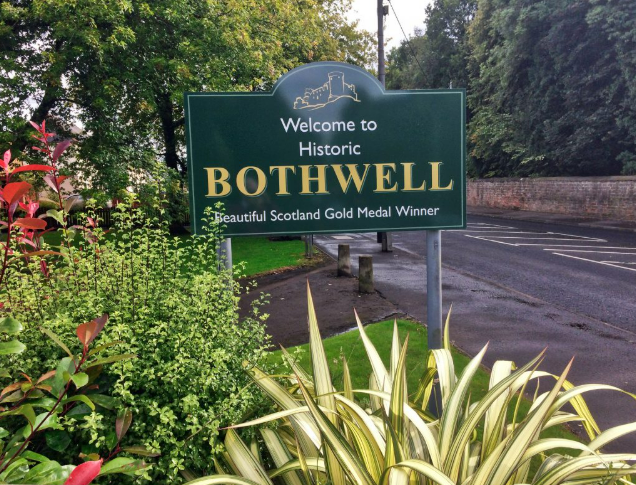
Although situated on the River Clyde and near to the centre of Scotland’s motorway system with major links close by, Bothwell has the air of being ‘off the beaten track’. Despite being a modern and vibrant community, this conservation village of 10,000 people (2024), boasts a long and dramatic history that parallels the history of Scotland. The Romans established a military camp at nearby Bothwellhaugh. St. Mungo, patron saint of Glasgow, sent out his acolytes from the city in the sixth century to found a Christian settlement at a pagan shrine. The present parish church, part medieval and part Victorian, stands on the same site.
In the 12th century Bothwell’s earliest ruling family, the Olifards, built a motte and bailey castle near the present parish church. Later lords of Bothwell built a great new stone castle on the banks of the Clyde in the late 12th century. Besieged by both Edward I and Edward III of England, this castle, under the Douglas family, Bothwell Castle would become more palace than fortress. Part of it was demolished in the late 17th century to build a new mansion, Bothwell Castle House. This, after several re-buildings, would become a stately home for the Douglas-Homes. It was demolished in 1930. Bothwell Castle ruins can be visited (Historic Scotland).Bothwell Bridge is so ancient that its origins are unknown, but as it has done for centuries, still provides an important river crossing. Here in 1679 the Covenanters, members of a religious and political movement, who supported a Presbyterian vision for the Church of Scotland, fought in vain against the government’s army under the Duke of Monmouth. A monument to the battle may be seen at the bridge. Several famous personalities have been associated with Bothwell down through the centuries including William and Dorothy Wordsworth, Sir Walter Scott and James Boswell. Present-day Scottish literature is represented by the author Christopher Brookmyre, who lives in the village.

The industrial revolution came to Bothwell in the later part of the 19th century. There were two railway stations and lines that serviced the village and Bothwell Castle Colliery in its centre. The coal mining and railways lasted until the middle of the 20th century.
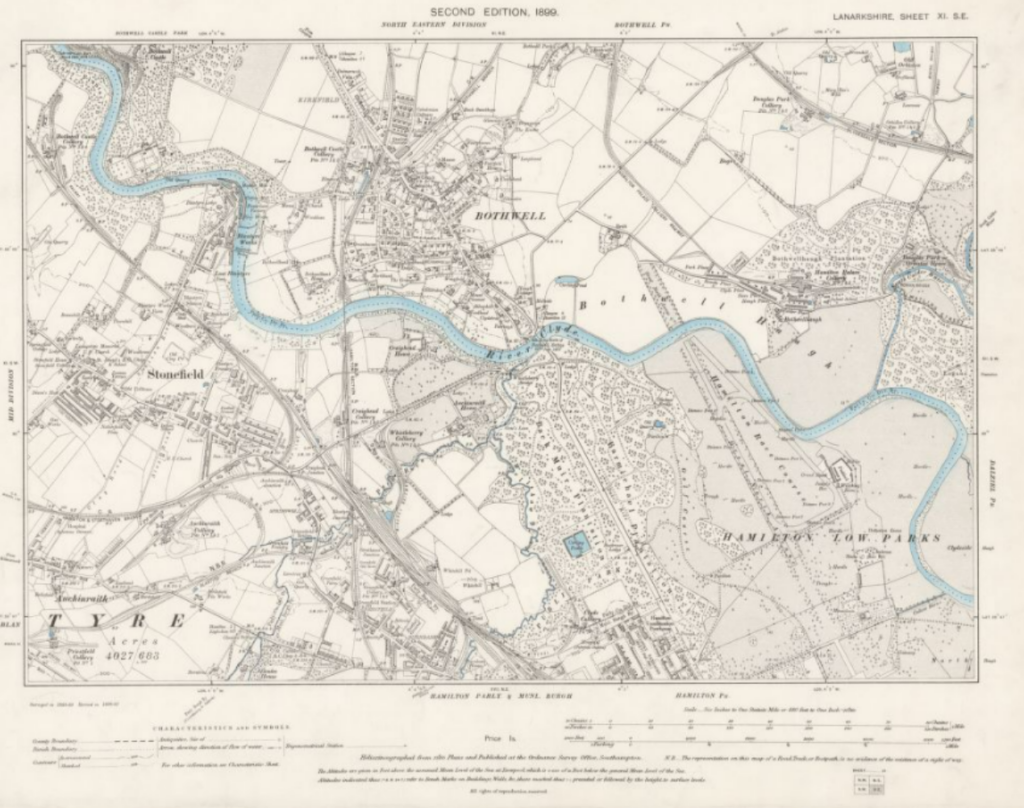
Bothwell Historical Society and the Bothwell Historical and Heritage Society.
Through research, publications and talks, the community’s history was promoted by the Bothwell Historical Society (BHS) between 2011 and 2020. In 2024, a new group was established, the Bothwell Historical and Heritage Society (BHHS), to carry on promoting local history in the village.
Location of and Access to Bothwell
Located in the Central Belt of Scotland, Bothwell is situated just off Junction 5 of the M74 to the southwest of Glasgow. Its central location provides the motorist with easy access to the major cities and regions of Scotland. It is also served with a convenient bus and train network. The village is located midway on the Clyde Walkway, a long distance walking and cycling trail that extends 40 miles through the scenic Clyde Valley and links the centre of the City of Glasgow to New Lanark in South Lanarkshire. The village sits on the national Cycle Route 74/75. Strathclyde Country Park is situated nearby. It has a caravan and camping park and hotel, and the park offers a wide range of water sports and other visitor attractions. It links to the nearby Baron’s Haugh Bird Reserve (RSPB) and the Dalziel Estate and Chatelherault Estate with their unrivalled variety of woodland and riverside walks.
Other Bothwells
There are three other communities named Bothwell across the globe in Tasmania, the United States, and Canada.